




Smaller and quieter than its Balearic neighbor, Ibiza, Formentera reveals itself slowly. Most travelers arrive by ferry, crossing the turquoise stretch from Ibiza Town to the island’s modest port at La Savina—a short and scenic journey that becomes a subtle transition into a different rhythm. It is a place of salt flats and wind-shaped junipers, of pale roads stretching toward distant horizons, of water so clear it feels almost unreal. Here, travel becomes less about movement and more about presence.
On the long southern shoreline of Migjorn beach, where pine forest meets sand and light shifts gently across the day, Hotel Teranka emerges not as a spectacle, but as something quieter and more deliberate.
It feels less like arriving at a hotel—and more like entering a world within a world.
The Spirit of Formentera
Formentera has always resisted excess. Long before “slow travel” became a philosophy, the island lived it naturally. There is no airport here. Arrival requires intention. Visitors cross water before they arrive—and in doing so, leave something behind.
Perhaps that is why those who come tend to stay longer than planned. Artists arrived decades ago, drawn by the silence and extraordinary Mediterranean light. Writers followed. Musicians stayed. Travelers searching not for spectacle but for clarity discovered something rare: a place where rhythm returns to the body instead of the calendar.
Formentera rewards those willing to listen—to wind through juniper trees, to bicycles instead of traffic, to the quiet space between conversations. Hotel Teranka belongs precisely to this tradition.
At One with the Landscape
Teranka does not attempt to dominate its surroundings. Instead, it collaborates with them.
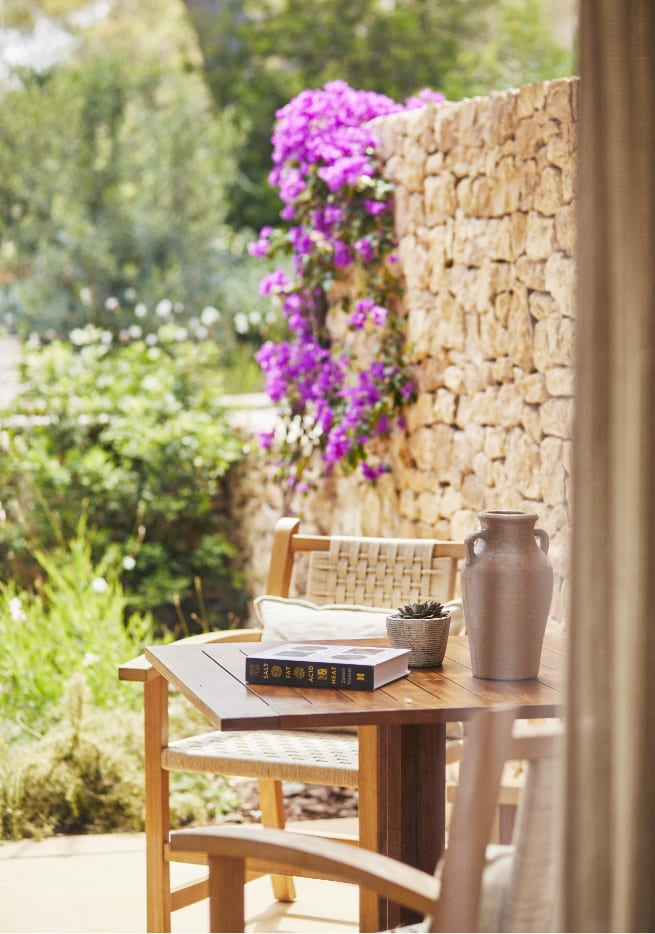
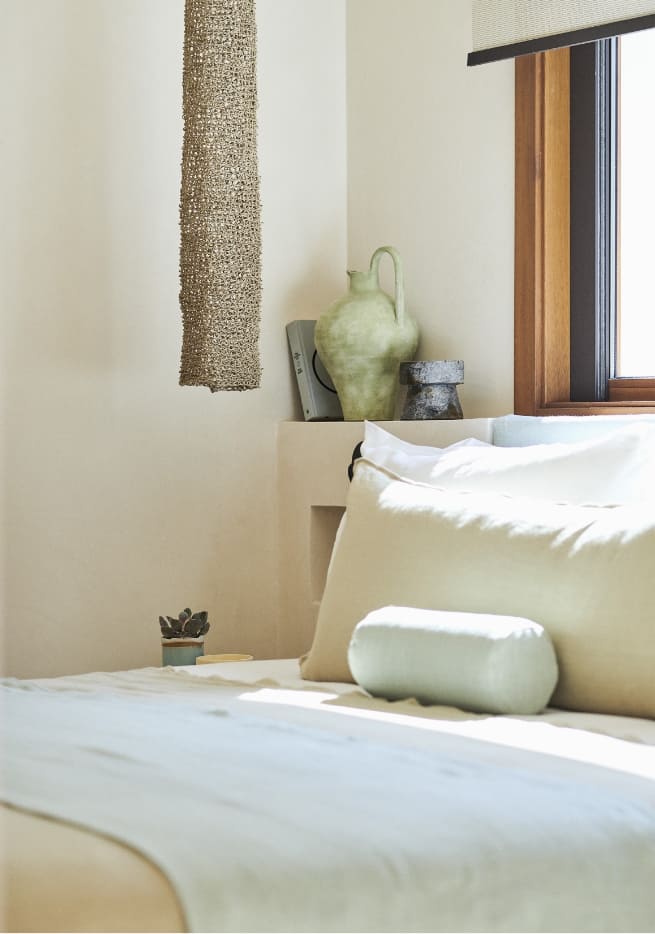
Spread across three distinct buildings—Mar, Tierra, and Cielo—the hotel creates a subtle architectural dialogue between sea, land, and sky. Natural materials shape the experience: linen, pale woods, textured stone, and filtered Mediterranean light moving gently through open interiors.
Rooms feel intentionally calm rather than decorative. Nothing competes for attention. Instead, the eye rests—and then begins to notice small details: shifting shadows across walls, framed fragments of sea beyond pine branches, the scent of warm forest drifting through open windows. This is architecture designed not to impress, but to breathe.
A World Within a World
Teranka describes itself as “a world within a world“—and the phrase feels less like a tagline and the description feels less like a tagline and more like a quiet truth. The hotel unfolds as a layered homage to an elemental Mediterranean paradise, where contemporary artworks, antiques, books, and carefully chosen objects create a dialogue between past and present. These elements do not decorate the space; they shape its atmosphere.
This is not minimalism for its own sake. It is a curated expression of Formentera’s barefoot counterculture heritage—one rooted in craftsmanship, ancestry, and storytelling rather than trend. There is a sense that everything here has been selected with intention: textures that echo the island’s terrain, artworks that respond to its light, objects that invite curiosity rather than display status. Teranka feels lived rather than styled. And that distinction changes everything.
The sea, once it casts its spell, holds one in its net of wonder forever.
Art, Music, and the Culture of Stillness
Teranka is not only a place to stay. It is a place to observe. Throughout the property, contemporary art appears in quiet conversation with landscape rather than apart from it. Sculptural gestures emerge along pathways. Interiors reveal unexpected details slowly. Nothing feels staged for attention.
Even music follows the same philosophy. Rather than dominating the atmosphere, sound becomes part of the setting—soft evening rhythms, intimate live sessions, moments that feel discovered rather than scheduled. The result is rare: a hotel that understands culture not as entertainment, but as environment.
Living Between Sea and Pine Forest
One of Teranka’s quiet privileges is its location along Migjorn beach. Here, the shoreline stretches long and uninterrupted, shifting between sand and rock shelves where turquoise water glows even in shadow. Mornings arrive gently. Afternoons extend without urgency. Evenings seem designed for walking rather than planning. Guests move naturally between three elements: the sea the forest, the sky.
Together, they create the rhythm of the stay. Time expands here. Conversations last longer. Books remain open for hours. Meals continue after sunset without anyone noticing when night arrived. And somehow, nothing feels scheduled.
The New Mediterranean Luxury
Teranka represents something increasingly rare in contemporary hospitality. It does not try to impress. Instead, it offers space—space to swim, to read, to walk, to think, or simply to sit with the horizon until the day changes color. Its luxury lies in restraint, in silence, and in the confidence of not needing to be louder than the island itself.
In a Mediterranean increasingly shaped by visibility and velocity, Teranka quietly proposes another possibility: that the most meaningful journeys are sometimes the quietest ones.
And that somewhere between sea, forest, and sky, Formentera still remembers how to slow the world down.
About the author

-
 The Quiet Architecture of Nomos Hotel Rome
 -
 Mastering the Digital Nomad Lifestyle: How Minimalism and Adaptability Can Become Superpowers
 -
 Naladhu Private Island: A Legacy of Serenity and Stewardship
 -
 When Investment Strategy Matters More Than Speed
 -
 Komodo Island, a Reminder of Nature Unchecked





Leave a Reply