




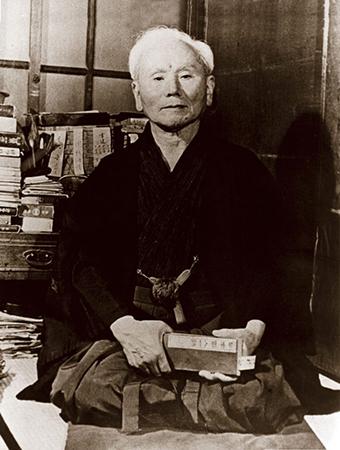
Dawn breaks over the Okinawan shore. A solitary figure moves in silence, his hands tracing patterns in the misty air—each motion a dialogue with invisible opponents, each breath a meditation. There is an apparent contradiction at the heart of karate. It teaches the body to generate power, yet asks the person possessing that power to practice restraint. It prepares someone to confront an opponent, while suggesting that the most difficult opponent may be found within. Few understood this contradiction more profoundly than Gichin Funakoshi.
Remembered as the father of modern karate-do, Funakoshi helped carry a little-known Okinawan martial art to mainland Japan and, eventually, the wider world. Yet the true significance of his legacy lies not simply in how far karate traveled. It lies in what he believed karate could become: a discipline through which technique shapes character, physical strength acquires moral responsibility, and the empty hand becomes a lifelong path.
Before Karate Became a Global Language
Funakoshi was born on 10 November 1868 in Yamakawa, Shuri, Okinawa, into a family descended from retainers of the former Ryukyu Kingdom. He grew up during a period of political and cultural transformation, when Okinawa’s distinct identity was being absorbed into modern Japan.
He began studying Ryukyuan martial arts at around age 11 under two respected masters, Azato Anko and Itosu Anko. At the time, karate was not the organized, publicly taught discipline we recognize today. It was still a regional tradition, transmitted personally from master to student, often away from public attention.
Funakoshi was not only a martial artist. He was a schoolteacher, and that distinction would influence everything that followed. Where another practitioner might have concentrated on preserving fighting techniques, Funakoshi recognized karate’s potential as a form of education.
It could certainly train the body. More importantly, it could teach patience, courtesy, responsibility and composure. The objective was not merely to create a more capable fighter, but a more disciplined human being.
The Demonstration That Changed Everything
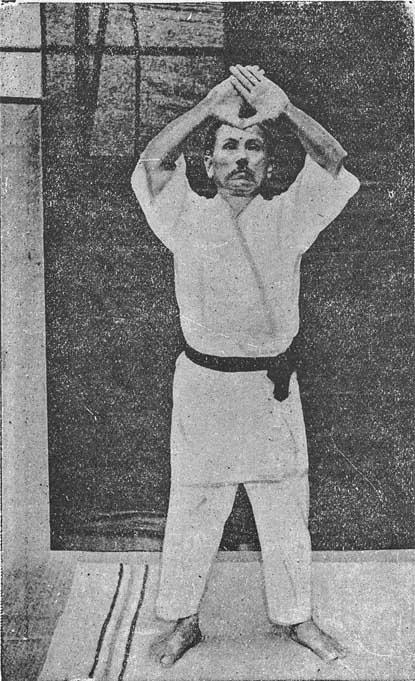
In 1922, at the age of 54, Funakoshi traveled from Okinawa to Tokyo to participate in the First Budo and Physical Education Exhibition, sponsored by Japan’s Ministry of Education.
His presentation of Okinawan karate attracted considerable attention. Jigoro Kano, the founder of modern judo, invited Funakoshi and his student Gima Shinkin to demonstrate kata at the Kodokan, the center of Japanese judo. The response encouraged Funakoshi to remain in Tokyo and continue teaching.
What followed was not an overnight transformation but a gradual process of translation—between Okinawa and mainland Japan, between a private tradition and a public discipline, and between physical technique and a philosophy that could be understood beyond its place of origin.
Funakoshi lectured, demonstrated, and taught wherever space was available. He worked with schools and universities, and karate clubs began appearing across Japan’s higher education institutions. In the same year that he arrived in Tokyo, he published Ryukyu Kempo Karate, introducing the art to a much broader readership. In 1924, he issued karate’s first dan-ranking certificates. Japan Karate Association
These developments gave karate a structure through which it could grow. But Funakoshi was also changing the way the art was understood.
What It Means to Have Empty Hands
The transformation is contained within the name itself. The word karate had originally been written with characters that could be interpreted as “Chinese hand,” reflecting Okinawa’s long cultural relationship with China. Funakoshi adopted different characters with the same pronunciation, changing the meaning to “empty hand.” On one level, the phrase described a method of defending oneself without weapons. Yet emptiness also carried a spiritual meaning.
While living in mainland Japan, Funakoshi practiced Zen and reflected on the Buddhist understanding of emptiness. An empty mind was not a vacant one, but a mind less constrained by ego, fear, anger and fixed assumptions. It could observe clearly and respond freely.
The empty hand therefore suggested more than the absence of a weapon. It represented the possibility of meeting the world without being ruled by the impulse to dominate it.
Funakoshi also moved away from the term karate-jutsu, meaning karate technique, in favor of karate-do. The Japanese word do means “the way” or “the path.” Its addition shifted the emphasis from what a practitioner could do to the person they might become through doing it. Technique could be learned. A way had to be lived.
A Name Borrowed From Poetry
Funakoshi wrote poetry and practiced calligraphy under the pen name Shoto, commonly translated as “pine waves.” The dojo smelled of tatami straw and pine resin. Outside, cicadas drummed their relentless rhythm, as Funakoshi’s students bowed in reverence, their hearts pounding with anticipation. Shoto evoked the sound of wind moving through pine trees like waves across the sea.
When a permanent dojo was built for him in Tokyo in 1939, his students named it Shotokan: Shoto’s hall. It was an affectionate tribute, not the name Funakoshi had chosen for a separate style of karate. Only later would Shotokan become associated with the tradition that developed from his teaching.
There is something revealing in the fact that one of the world’s most recognizable martial arts traditions carries a name drawn from poetry. It reminds us that Funakoshi’s world was never limited to physical force. Discipline could coexist with sensitivity; power with quietness; repetition with imagination.
The original Shotokan dojo was destroyed during the Tokyo air raids in 1945. Yet the principles it represented survived. Funakoshi’s followers regrouped after the war, and in 1949 the Japan Karate Association was established with him as Supreme Master.
Karate Beyond the Dojo
Funakoshi expressed his philosophy through the Twenty Precepts of Karate: principles concerned with courtesy, self-knowledge, vigilance, humility, and restraint.
The first teaches that karate begins and ends with rei—respect or courtesy, physically expressed through the bow. Another declares that there is no first attack in karate. Others remind the practitioner to understand themselves before judging others, to value the cultivation of the mind above the application of technique, and never to imagine that karate exists only inside the dojo.
The message running through them is clear: the meaning of training is revealed in ordinary life.
It appears in how we respond when offended, how we behave when we possess an advantage, and whether we can remain composed when circumstances do not bend to our wishes. A perfectly executed technique means little if the person performing it remains governed by arrogance or anger.
Funakoshi understood karate as a lifelong practice because character is never conclusively mastered. The student may progress through ranks and acquire considerable ability, but there will always be another impatience to confront, another fear to understand, and another assumption to release. The dojo provides the setting. Life provides the examination.
The Responsibility of Strength
Martial arts are easily associated with victory: one person overcomes another, one technique prevails, one body proves stronger. Funakoshi’s philosophy complicates that picture.
Karate teaches a person how to strike, but also why not to strike. It develops power while demanding control over its use. The more capable a practitioner becomes, the less casually that capability should be displayed.
This is why etiquette is inseparable from training. The bow is not decoration. It acknowledges the teacher, the tradition, the space and the training partner. The person standing opposite us allows us to practice, fail, improve, and understand our own limitations. Without them, there is no progress. Seen in this way, the opponent is not necessarily an enemy. Sometimes, the opponent is the person who reveals us to ourselves.
By learning to confront another body, the practitioner encounters their own body. By meeting external pressure, they discover their internal reactions. Fear, pride, and anger rise to the surface, where they can be observed rather than obeyed.
Perhaps this is karate’s most demanding lesson: possessing strength does not entitle us to use it. True control begins when we recognize that we could cause harm and consciously choose another response. The ultimate aim of karate lies not in victory or defeat, but in the perfection of character.” Funakoshi would remind his pupils, his voice steady as the autumn wind.
The Mind Learns to Become Still
The physical and spiritual dimensions of karate were never separate in Funakoshi’s vision. Repetition gradually trains the body to move without hesitation, but it also teaches the mind to become quieter.
The Japan Karate Association describes this as the simultaneous development of body, mind, and spirit. Through the constant practice of kihon—fundamental techniques—kata—formal sequences—and kumite—partner training—the body learns to act naturally while the mind remains present and still.
This stillness is not passivity. It is the ability to perceive a situation without immediately being captured by it. A calm mind may act decisively when necessary, but its action does not arise from panic or ego. Strength, then, is not simply muscular. It is the ability to remain whole under pressure.
A Legacy Measured in Character
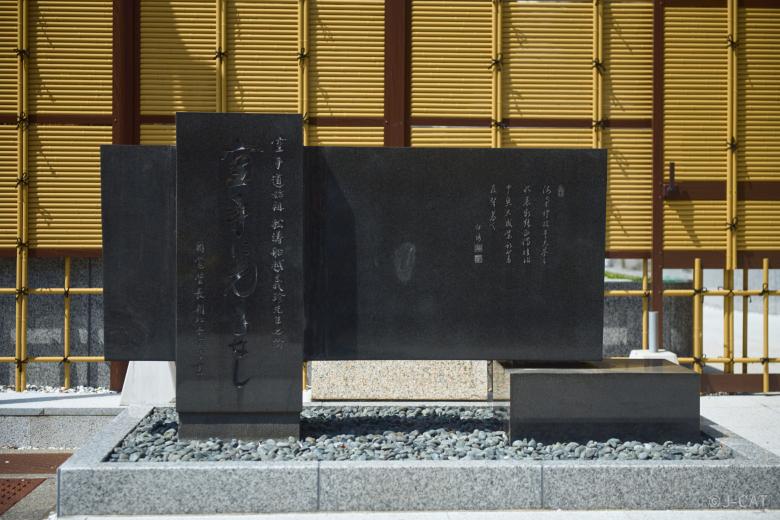
Funakoshi continued teaching and promoting karate-do until he died in 1957. Sixteen days before he passed away, Japan’s Ministry of Education formally recognized the Japan Karate Association as a legal entity. More than 20,000 people attended his public memorial at Tokyo’s Ryogoku Kokugikan. A memorial to him now stands at Engakuji Temple in Kamakura, returning his story to the Zen thought that helped shape his interpretation of the empty hand.
His influence can be measured through the extraordinary international reach of karate. Yet numbers, organizations, and styles tell only part of the story. His greater legacy survives wherever karate is taught as a form of character education. It lives in the child who discovers that confidence does not require intimidation; in the practitioner who learns that provocation does not demand reaction; and in the stronger person who chooses to protect rather than dominate.
Funakoshi helped bring karate from Okinawa to mainland Japan, but his most important journey was philosophical. He moved the art beyond fighting without diminishing its physical power. He understood that technique and character could not be separated, because power without judgment was incomplete.
The hand may be empty, but it is not without purpose. And perhaps that is why karate-do continues to speak to people far beyond the martial arts: it asks not how much power we possess, but what kind of person we become once that power is placed in our hands. In the end, what remains is not the memory of battles fought, but the discipline of the empty hand—the promise of peace, born from restraint.
Image credit: AI-generated editorial illustration created for PassportTalk.




Leave a Reply